
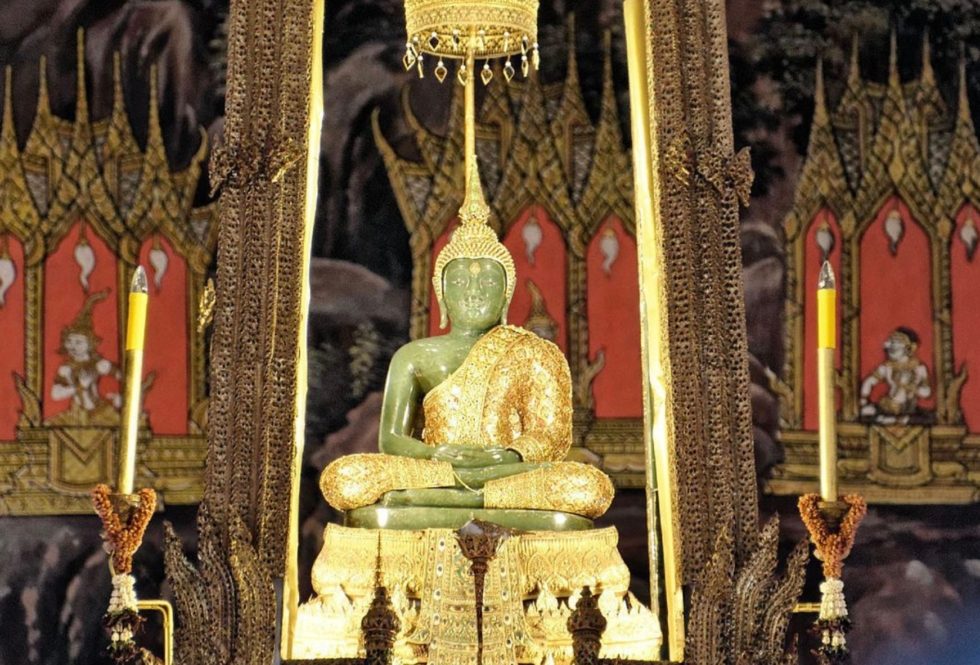
On the east bank of the Chao Phraya River, within the grounds of the Grand Palace, stands Wat Phra Kaew—the Temple of the Emerald Buddha and, by many accounts, one of the most sacred places in Thailand.
The temple itself is spectacular.
Gleaming stupas. Ornate buildings. Towering demon guardians.
The sort of place where an Instagrammer could exhaust an entire phone battery before reaching the exit.
But despite all that grandeur, the real star of the show is something remarkably small.
A Buddha image just over two feet tall.
The Emerald Buddha.
Its diminutive size gives little indication of its enormous importance.
Carved from a single block of green jasper, the statue is one of Thailand’s most revered religious and national symbols. It is regarded with such reverence that the seasonal changes of its golden robes are traditionally performed by the King.
And the little Buddha has quite a resume.
According to its traditional history, the statue spent centuries traveling through the kingdoms of Southeast Asia. It was associated with Chiang Mai, Luang Prabang and Vientiane before eventually arriving in Bangkok, where King Rama I installed it in the newly established Temple of the Emerald Buddha in 1782.
It was history’s original frequent flyer.
But perhaps the most remarkable part of its story is how the statue was discovered in the first place.
According to the traditional account, lightning struck a chedi in Chiang Rai in 1434, damaging the structure and revealing what appeared to be a plaster-covered Buddha image inside.
Nothing particularly extraordinary there.
Until some of the plaster on the statue’s nose began to crumble away.
Beneath it was green stone.
The plaster was eventually removed, revealing the Buddha image we know today.
A priceless religious treasure had been sitting there all along.
Hidden in plain sight.
As I stood among the visitors that day, looking up at this little green Buddha, I found myself thinking about its extraordinary journey.
This was the same statue that had traveled across kingdoms.
A statue that had been treated as a sacred treasure wherever it went.
A statue important enough to be claimed, protected, moved, and fought over.
And yet…
There it was.
Twenty-six inches tall.
I found myself wondering if someone seeing it for the first time might have the same reaction I did:
“This is it?”
And perhaps that’s exactly what makes the Emerald Buddha’s story so fascinating.
We have a tendency to measure importance by size.
The bigger the building, the grander the monument. The taller the statue, the more impressive the achievement.
But history doesn’t always work that way.
Sometimes something small can carry an extraordinary amount of meaning.
The Emerald Buddha is small enough to fit comfortably on a tabletop.
Yet for centuries, it has represented something much larger than itself: faith, power, tradition, history, and the enduring devotion of generations.
Perhaps that is what I found most remarkable about standing before it.
Not that such a small statue could be so impressive.
But that something so small could carry so much history.
And perhaps that is the lesson the little Buddha quietly offers:
Never assume that importance can be measured with a ruler.
Until next time.
Wat Phra Kaew, Temple of the Emerald Buddha, Bangkok, Thailand.


