
Let’s be honest: you can’t throw a stone in Southeast Asia without hitting a temple. They are everywhere—sprawling across blazing Bangkok concrete, crowning misty coastal peaks, and hiding inside forgotten caves. Some of them are even off the side of the road.
As a bonafide vagabond of this region, I’ve made it my personal mission to explore as many as humanly possible. I’ve shared space with chanting monks, punished my glutes on endless staircases, and learned the hard way that sometimes the true gatekeeper of a sacred site isn’t a holy man—it’s a macaque eyeing your water bottle.
Traditional guidebooks only give you the history. Here’s the reality.
Spiritual Geographyless: A Non-Guidebook to Southeast Asia’s Sacred Spaces.
Rather than a Michelin guide to all things spiritual, think of this as my own personal classification of the region’s sanctuaries—a field guide to the divine, the chaotic, and the sweaty based on nearly a year of wandering. I’ve taken my temple trips and broken them down into four of my favorite custom pillars: Animals & Elements, Elevation & Endurance, Mythology & Lore, and The Hidden & Serene.
Whether you’re here for the physical triumph of a 1,200-step climb or the quiet magic of an empty cave, you’re in the right place.
Fur, Fangs, and Feathers: Meeting the Local Welcoming Committees
When you picture a visit to a sacred Southeast Asian temple, you probably imagine a serene landscape: the gentle chime of bells, the scent of burning incense, and a profound sense of inner peace. What you might not picture is a standoff with a tiny, furry pirate who is actively weighing the street value of your sunglasses.
In this part of the world, the true gatekeepers of the sacred aren’t always the monks—sometimes they are the local wildlife. And let’s be clear: I am not complaining. These furry welcoming committees have become some of my absolute favorite travel companions, even if they occasionally make me wonder exactly how far away the nearest rabies clinic is.
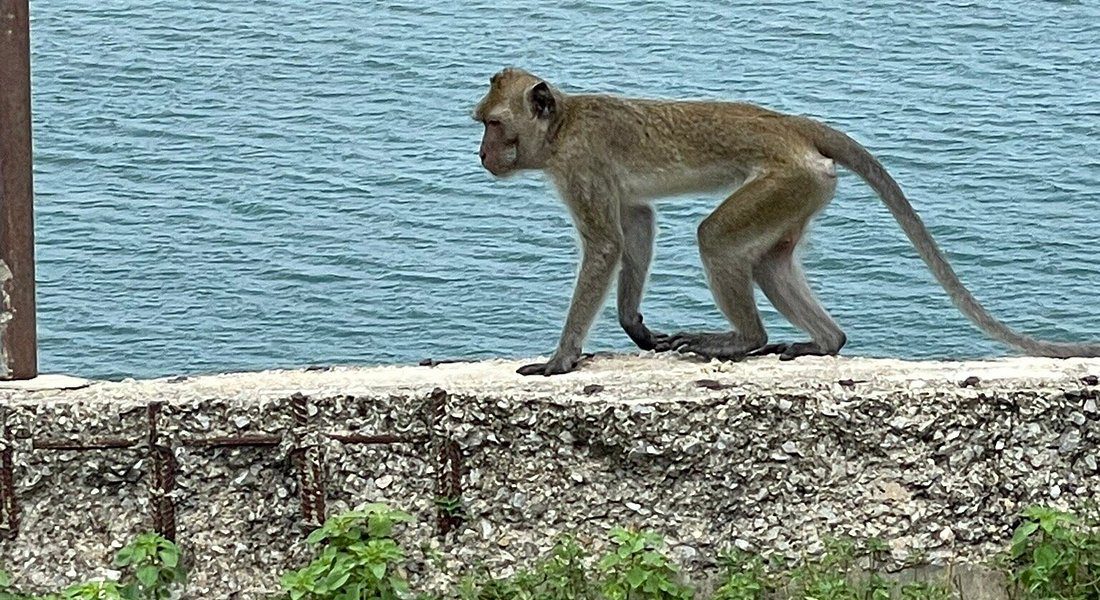
Take Wat Khao Takiab, for example. The locals call it “Monkey Mountain,” a title that feels like an understatement when you find yourself surrounded by a population that easily tops 1,000 residents. Coming from a world where monkeys were strictly “behind glass” zoo exhibits, being suddenly dropped into their living room was a trip. My guide warned me at least six times: “Do not make eye contact!”—a rule that sounds easy until a macaque decides to casually walk right past your shins.
Then there are the stair-lining critics at Tiger Cave Temple Peak. During my infamous attempt at its 1,260 steps, the local monkeys weren’t just spectators; they were high-altitude buccaneers. As I sweated my way upward, the air was filled with the tragic shrieks of tourists losing phones, hats, and snacks to the treetops. For some reason, they took pity on my struggle and left me alone, though they did watch me with an unmistakable look of pure skepticism.
But it’s not all chaotic monkey business. Closer to my new home, my daily two-mile morning walk takes me to Wat Khao Krailart. When I first started, I was regularly greeted by a 10-dog security detail that barked like crazy. Today? They recognize me as a local and go on about their naps. These well-fed, monk-adored temple dogs have transformed from a rowdy welcoming committee into my personal morning greeting club.
Survival Tips for the Uninitiated:
If you are heading out to these sites, pack your sense of adventure—but leave your snacks in the hotel. Here is my battle-tested advice for surviving the local committees on friendly terms:
Hide everything: If it looks like food, smells like food, or is attached to your face (looking at you, sunglasses), secure it.
The No-Smile Zone: Avoid showing your teeth. In human world, it’s a smile. In monkey world, it’s a declaration of war.
Skip the eye contact: Look at the architecture, look at the view, look at your shoes. Just don’t lock eyes.
The ultimate truth: Secure your wallets. If these temple monkeys ever figure out how to use Venmo, humanity is officially doomed.
Stairways to Heaven (And the Calorie Burn to Match)
I am no spring chicken. If I chose to spend my travels lounging at beachside cafes rather than punishing my knees, nobody would blame me.
Yet, there is a distinct, borderline addictive thrill that comes with mastering a grueling set of temple stairs and being rewarded with a panoramic, 360-degree view that leaves you breathless (both from the beauty and the lack of oxygen).
Beyond the views, these climbs offer a profound history lesson. As you wipe the sweat from your eyes, you realize that every single brick, statue, and tile of these sanctuaries was carried up the mountain by hand. With no roads or heavy machinery, these structures were built on pure, unadulterated faith and devotion. It is a level of human dedication that never fails to leave me in awe.
But sometimes, the mountain wins.
When I approached Tiger Cave Temple Peak last November, I felt like a seasoned pro. I had already notched the 800-some steps to Christ the Redeemer in Vung Tau under my belt. I had successfully conquered the 500+ uneven, rugged stone steps leading to the Dragon’s Peak at Hang Mua in Ninh Binh. Surely, Tiger Cave Temple’s 1,260 steps would just be another day at the office.
What I failed to factor into my mathematical equation of confidence was that I had just spent two hours soaking in the nearby Emerald Hot Springs. The relaxing waters had effectively turned my leg muscles into warm Thai jello. I hit a wall about halfway up and had to call it quits. But consider this a cliffhanger: I am actively training for a second assault this January, and I fully intend to claim my redemption.
Closer to my new home base in Hua Hin, the hills are a bit friendlier.
There are about six hilltop temples dotting the local landscape. While none of them pose the brutal, vertical challenge of Tiger Cave Peak, they each offer their own unique rewards. I’ve already successfully summited three of them, proving that while my neckties are retired, my hiking boots certainly aren’t.
Meet you at the top.
Crocodiles, Kings, and Cosmos: The Legends Behind the Stone
I am a total sucker for a good story. And if you scratch beneath the surface of Southeast Asia’s magnificent temples, you will find that the folklore behind the stone is just as legendary as the architecture itself. It seems that no matter where my hiking boots take me, there is a fascinating tale waiting to be uncovered. Sometimes it’s a story about an elephant blazing a sacred trail; other times, it’s a moral lesson from a reincarnated reptile.
Take my visit to Chiang Mai’s gleaming Wat Phra That Doi Suthep. Built centuries ago—long before anyone had even dreamed of paving a road up the mountain—its origin story hinges on a heavy dose of divine intervention. Legend has it that a sacred Buddhist relic was strapped to the back of a royal white elephant, which was then released to roam freely. The elephant marched up the mountain, trumpeted three times, knelt down, and passed away. Talk about an omen. The monks took it as a cosmic green light, and Doi Suthep was built on that exact spot.
Then there is the folklore surrounding Wat Khao Kalok, a tale that would have even Crocodile Dundee raising an eyebrow. According to local lore, a wealthy but staggeringly stingy man used to hoard his gold, burying it beneath his boat dock rather than sharing his blessings or making merit. When he died, karma handed him a rather literal reality check: he was reincarnated as a profoundly ugly crocodile, doomed to spend his days swimming around the dock to guard his useless wealth. After years of suffering, he appeared to his son in a dream, begging him to dig up the gold and donate it to the temple to break the reptilian curse. It’s a vivid, snappy lesson in shedding greed that still echoes through the temple grounds today.
But it was at Wat Khao Noi that a simple statue taught me one of the most beautiful lessons yet. This temple overlooks the coast and is home to an impressively large, countless number of… peacock statues. You read that right. Not elephants, and not menacing Naga serpents. Peacocks.
As the resident monk explained to me (and eat your heart out, Marlin Perkins, because I certainly didn’t know this), the peacock is famous in Buddhist lore for its ability to eat poisonous plants and venomous creatures without dying. The living lesson? We must not allow the negativity and evils of the world to consume us. Instead, we have to learn to absorb life’s toxins and transform them into something beautiful.
And honestly, that might be the most beautiful legend of them all.
- [Link to Doi Suthep Post: The White Elephant’s Final March]
- [Link to Wat Khao Kapok Post: The Croc Who Hoarded Gold]
- [Link to Wat Khao Noi Post: What Peacocks Can Teach Us About Life]
Accidental Serendipity: Hidden Caves and Quiet Corners
Not all my temple trips have involved staring downs with wild monkeys or dodging crocodiles. Some of the best moments have actually been the quieter, more reflective ones where I just got to slow down and take it all in.
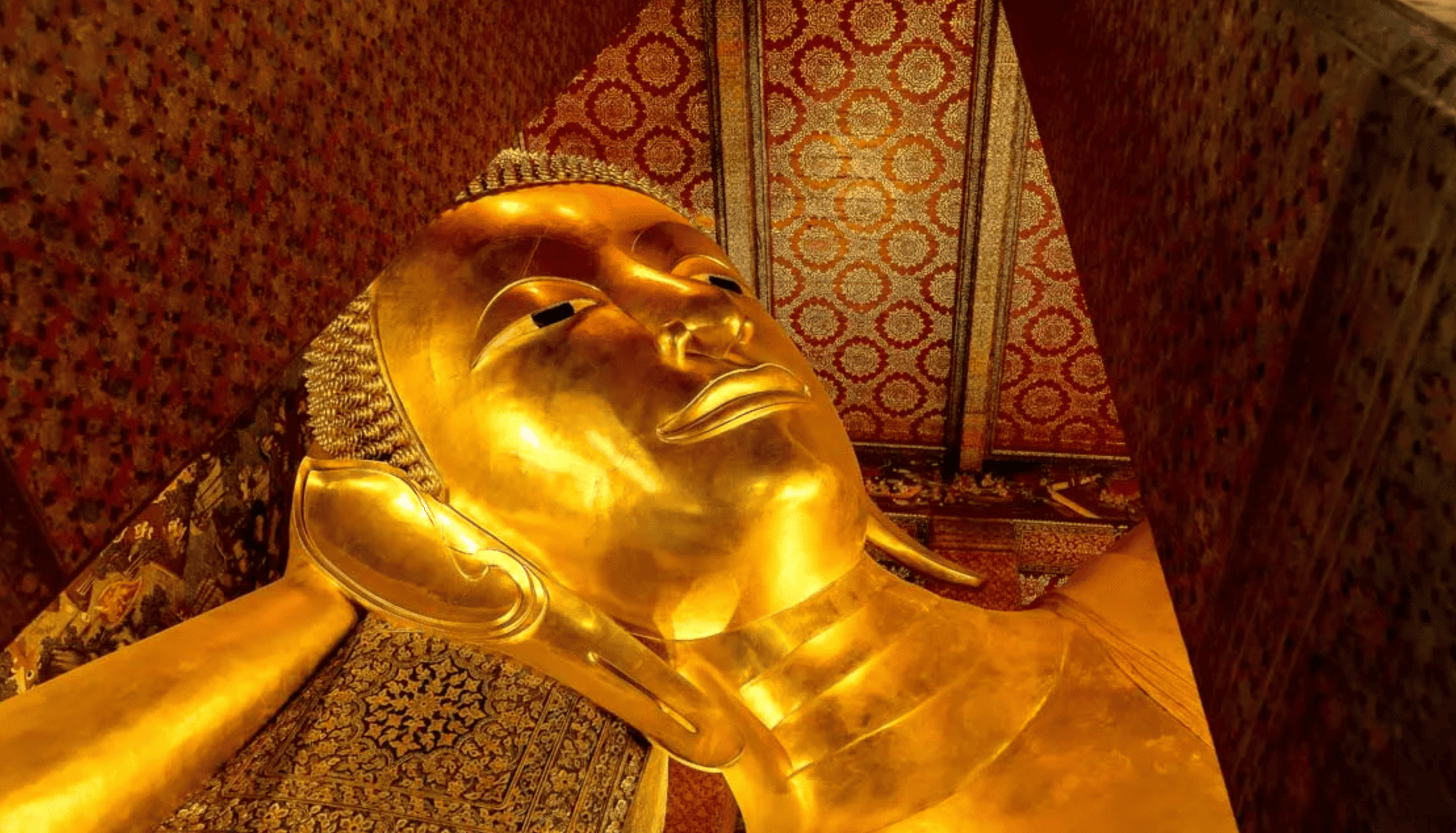
Take my visit to Wat Pho in Bangkok, where I first set eyes on the magnificent Reclining Buddha. Imagine a statue stretching over 151 feet long, gleaming hand to foot in glittering gold leaf. The thing is so massive that you practically need to be a professional photographer just to squeeze it into a single frame. The way the light shimmers off the gold honestly gives you the illusion that the Buddha is softly breathing.
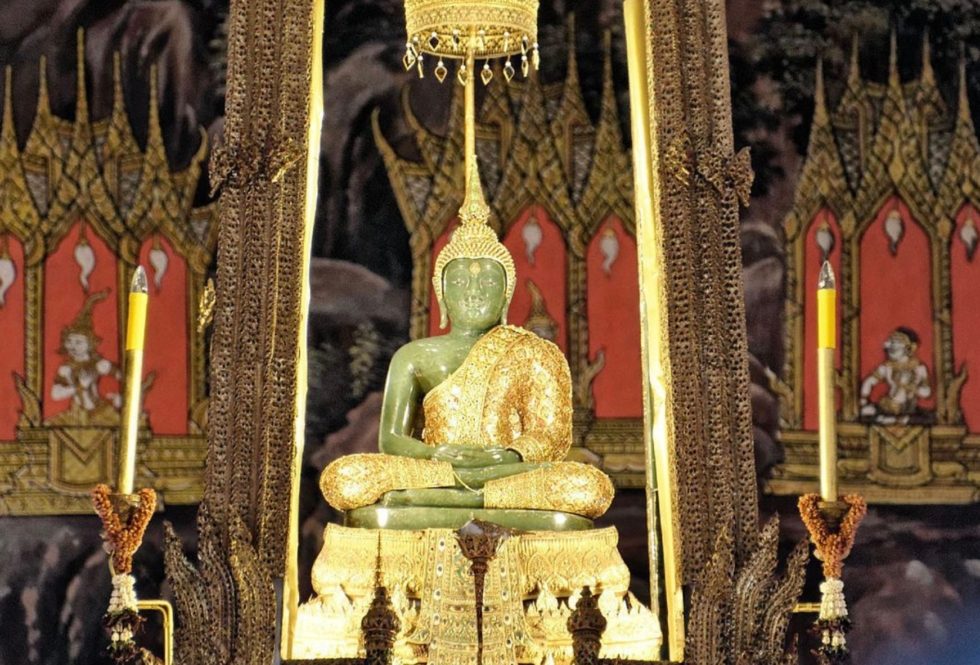
Across the river at the Grand Palace complex, stands Wat Phra Kaew, home to the Emerald Buddha. Unlike its giant neighbor, this sacred relic is barely over two feet tall. But the legend behind it is way larger than its tiny size suggests. Kings have fought for him, and armies have marched for him. Standing in its presence is a true, awe-inspiring moment.
Moving away from the traditional, one of the most unique religious sites I’ve ever explored isn’t a typical church or shrine at all. It’s the Sanctuary of Truth in Pattaya. Built entirely out of wood without a single metal nail or screw to its name, this massive structure is organized into four main philosophical halls. It beautifully weaves together Buddhism, Hinduism, Taoism, and Khmer beliefs, serving as a striking reminder that we all originate from the same basic elements and share the exact same ultimate destination. I also think it is worth noting that the sanctuary is still under construction — a not so subtle reminder that we all are.
A bit closer to home—about an hour south of Hua Hin—is the Phraya Nakhon Cave inside Khao Sam Roi Yot National Park. Unlike a lot of popular destinations that can sometimes feel a bit manufactured to me, Phraya Nakhon gave me a profound sense of earned discovery. I had to huff and puff my way up several hundred steep steps to reach it, but the physical effort made the destination so much sweeter. When I finally stepped into the cavern and watched the morning sunlight pour through that massive natural skylight and casting a glow on the tiny royal pavilion below, it took my breath away. (Then again, it might have been the climb.) It felt less like a tourist stop and more like a hard-won reward.
Big or small, wooden or stone, gleaming or hidden deep underground—these places don’t demand that you have all the answers. They just ask that you slow down long enough to listen.
And honestly? That’s a pretty good souvenir to bring home.
What? You still reading along?!
So, there you have it—my highly unofficial, completely un-guidebook-approved breakdown of Southeast Asia’s sacred spaces.
Whether you find yourself trading intense stares with a temple monkey over a stolen water bottle, nursing burning calves at the top of a grueling 1,200-step peak, getting lost in the ancient stories carved into stone, or sitting in the profound silence of a hidden cave… each of these places leaves a mark on you.
Temples in this part of the world aren’t just beautiful backdrops for Instagram shots. They are living, breathing epicenters of faith, endurance, nature, and history. You don’t need to be a religious scholar or a spiritual guru to appreciate them—you just need a bit of curiosity, a lot of respect, and maybe an extra bottle of water.
Best of all, you don’t need a rigid map to find something meaningful. Sometimes, the best sacred spaces are the ones you stumble into entirely by accident.
Just a few of my favorite temples and sacred spaces in Southeast Asia.