
For many travelers, a visit to Angkor Wat is the beginning and end of their Cambodian adventure. And fair enough — it is one of the most extraordinary places on Earth.
But just a short distance away lies the ancient walled city of Angkor Thom, the former capital of the Khmer Empire. And at its very center sits one of the most fascinating temples I have ever seen: Bayon Temple.
Now, nothing truly prepares you for Bayon.
Oh, sure, Angkor Wat overwhelms you with its sheer size and grandeur. But Bayon is different. Bayon doesn’t merely impress you.
Bayon stares at you.
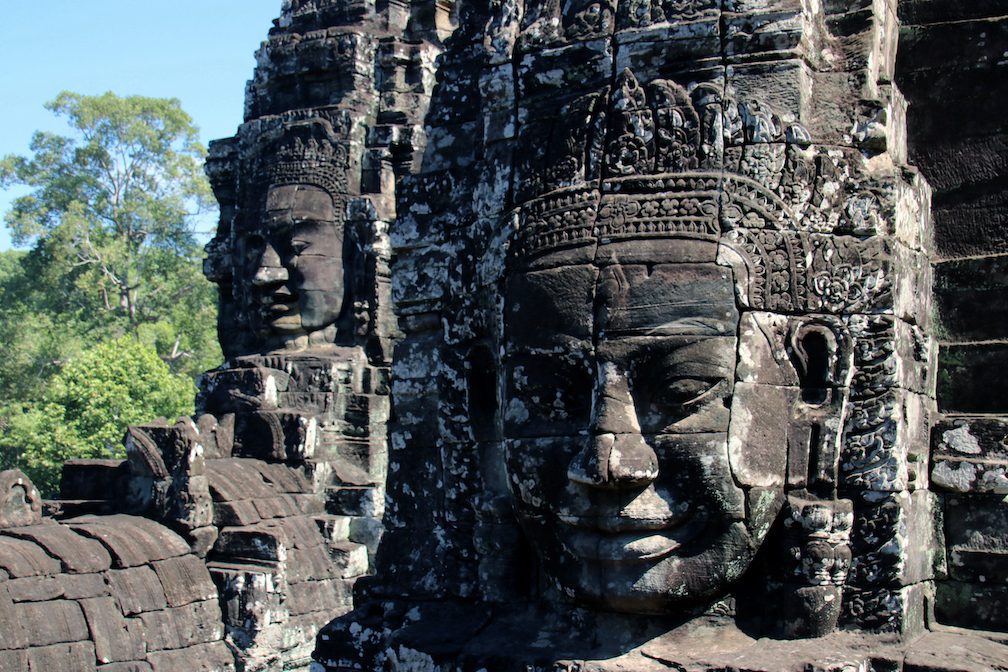
Imagine wandering through a maze of towering stone spires — more than fifty of them — each crowned with enormous carved faces gazing calmly in every direction. North. South. East. West.
Everywhere you turn… another face.
Watching.
Smiling.
Judging your life choices.
By the end of the tour, I was half convinced one of them had followed me into the parking lot.
There are nearly 200 faces throughout the temple, each bearing the same serene smile, elongated ears, and regal crown-like headdress. Scholars still debate exactly who they represent. Some believe they depict Buddhist deities. Others say they are modeled after King Jayavarman VII himself, eternally watching over his kingdom.
Personally, after spending an afternoon there, I’m fairly certain they represent my mother silently asking why I never call more often.
But the faces are only part of Bayon’s magic.
The temple walls are covered with intricate bas-reliefs depicting scenes of warfare, mythology, commerce, festivals, and ordinary daily life from centuries ago. Soldiers march into battle. Fishermen cast nets. Merchants barter. Families cook meals.
Stories carved into stone long before Columbus got lost looking for India.
What makes Bayon especially fascinating is that it evolved over time. The original temple commissioned by Jayavarman VII looked very different from what stands today. Successive rulers added their own religious influences and architectural touches over the centuries, blending Buddhist and Hindu symbolism into a single sprawling masterpiece.
The result feels layered, mysterious… almost alive.
And perhaps that’s why Bayon lingers with you.
Some places are beautiful. Others are historic. Bayon somehow feels conscious.
You don’t simply walk through it. You experience the strange sensation that it is quietly observing you in return.
So yes, if you visit the Angkor Archaeological Park, Bayon is absolutely a must-see.
Just be prepared for one small side effect:
For the rest of the day, every statue, tree stump, and hotel lobby decoration may briefly appear to have a face.
Watching.
Smiling.
Waiting.
Sweet dreams.
Until next time.
The many faces of Bayon Temple


❤️
How great. Thanks so much.
I am glad you enjoyed it, Janice.
Daryl I hope you compile these blogs into book someday. You write beautifully!
As your loving husband will no doubt attest, I lack the attention span for such an undertaking. 😀
Daryle
You sell yourself short, I also think you could do more with these short stories … but … then it may become WORK and that could interrupt that retirement thing you have going